
Important: This article is general information, not legal advice. Vehicle modification enforcement varies by state, so the article recommends checking with the relevant state transport authority before fitting — this protects both you and the reader from a black-and-white legal claim that isn’t accurate everywhere.
Note on internal links: Point these to your real live URLs before publishing.
Note on images: Filenames, alt text, and captions are below — drop in your own photography before publishing.
Are Sunvisors Legal in Australia? What You Need to Know
If you’ve searched “are sunvisors legal in Australia,” you’ve probably noticed the answer isn’t as simple as a yes or no. That’s because “sunvisor” actually covers two very different things under Australian vehicle law: the internal drop-down visor built into every car, and the external windscreen sunvisor fitted as an aftermarket accessory — the kind mounted above the windscreen on utes and 4WDs. This guide covers both, but focuses mainly on external sunvisors, since that’s what most people fitting an aftermarket accessory actually want to know.
The short answer: external sunvisors are legal in Australia, provided they’re fitted correctly and don’t breach the same general road rules that apply to any accessory near your windscreen. Here’s exactly what that means in practice.
 Alt text: are sunvisors legal in Australia example of correctly fitted external sunvisor Caption: A correctly fitted external sunvisor sits above the wiper sweep and doesn’t obstruct the driver’s view.
External vs Internal Sun Visors: Why the Distinction Matters
The internal sun visor — the padded flap that folds down inside your cabin — is covered by a specific national vehicle standard, Australian Design Rule (ADR) 11, which sets injury-reduction requirements for that component. Removing or modifying the factory internal visor can affect a vehicle’s compliance with ADR 11.
External windscreen sunvisors, the type fitted above the windscreen on the outside of the vehicle, aren’t covered by a specific ADR. Instead, they’re treated like most other exterior accessories — bull bars, weather shields, and roof racks fall into the same category — and are governed by general road rules around visibility, secure fitment, and vehicle dimensions rather than a dedicated visor regulation.
What Australian Law Actually Says About External Sunvisors
There’s no clause in the Australian Design Rules that specifically bans or restricts external windscreen sunvisors. What does apply, nationally and in every state, is the general road rule requiring drivers to maintain an unobstructed view of the road. This is the same rule used to enforce restrictions on windscreen stickers, dashboard clutter, and anything else that could block a driver’s line of sight — and in NSW alone, breaching it can carry a $349 fine and three demerit points, with similar penalties applying in Victoria, Queensland, and South Australia.
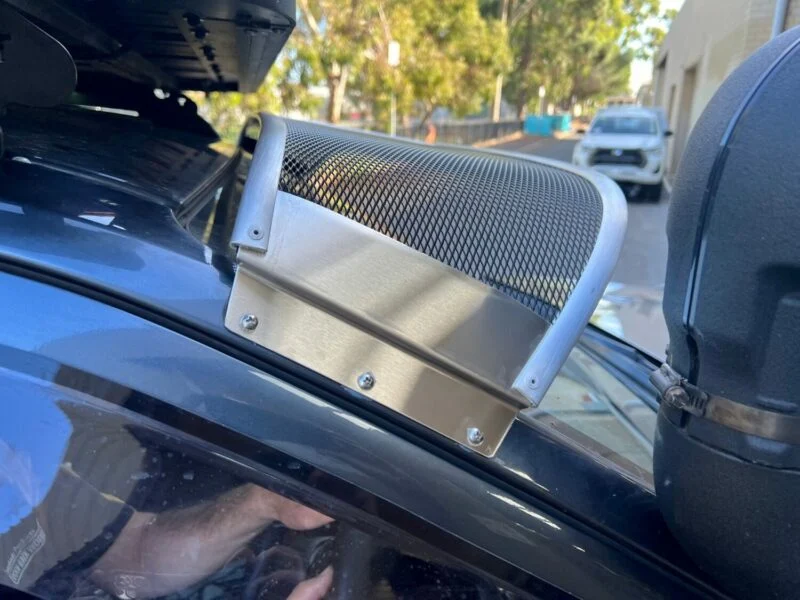
A correctly fitted external sunvisor, positioned above the swept area of the windscreen wipers and outside the driver’s direct line of sight, doesn’t breach this rule. Problems only arise when a visor is fitted too low, at an angle that intrudes into the driver’s forward view, or loosely enough that it could detach while driving.
Key Legal Requirements for Fitting an External Sunvisor
Whichever state you’re in, these four requirements cover the vast majority of compliance issues:
- Doesn’t obstruct the driver’s view — the visor must sit above the wiper sweep area and outside the driver’s normal line of sight.
- Securely fitted — a visor that can work loose or detach at speed is a genuine road hazard and can attract a defect notice.
- Doesn’t obscure plates, lights, or the compliance plate — this mainly matters for larger bonnet-mounted accessories, but it’s worth checking on trucks and larger 4WDs.
- Doesn’t exceed the vehicle’s approved external dimensions — rarely an issue for a windscreen-mounted visor, but relevant if you’re combining it with other wide-body accessories.
Does Fitting an External Sunvisor Affect My Roadworthy Certificate?
In most cases, no — a correctly fitted, cut-to-fit external sunvisor won’t affect a roadworthy or pink slip inspection. Inspectors are checking for the same things covered above: secure fitment and unobstructed visibility. A poorly fitted or damaged visor, on the other hand, can be flagged during inspection the same way a cracked windscreen or loose trim panel would be.
If you’re getting a roadworthy check soon after fitting a new visor, it’s worth mentioning it to your inspector so they can confirm it meets the requirements for your specific vehicle and state.
 Alt text: are sunvisors legal in Australia roadworthy inspection check Caption: A correctly fitted external sunvisor typically won’t affect a roadworthy inspection.
Internal Sun Visors and ADR 11: A Different Set of Rules
If your question is actually about the internal, factory-fitted sun visor rather than an external accessory, the relevant rule is ADR 11, which governs the injury potential of internal sun visors and the surrounding vehicle structure. This is why aftermarket replacement of a factory internal visor — as opposed to adding an external one — is treated differently and can affect a vehicle’s compliance if not done correctly. For most people researching external windscreen sunvisors for a ute or 4WD, ADR 11 isn’t the relevant rule, but it’s worth knowing the distinction exists.
State-by-State Considerations
Because enforcement of the “unobstructed view” rule sits with state and territory road authorities rather than a single national body, it’s worth doing a quick check with your local transport authority if you’re fitting a visor to a heavily modified vehicle, a commercial vehicle, or anything outside a standard passenger car or ute. This is especially worth doing if you’re combining an external sunvisor with other exterior accessories like bull bars, snorkels, or roof-mounted equipment, since the cumulative effect on visibility and dimensions is what inspectors assess, not any single accessory in isolation.
How to Make Sure Your External Sunvisor Stays Legal
- Choose a cut-to-fit visor for your exact vehicle model rather than a generic universal fit — poor fitment is the most common cause of visibility issues.
- Confirm it sits above the wiper sweep area, not intruding into it.
- Check the mounting is secure before your first drive, and periodically after, especially if you do unsealed-road driving.
- Avoid combining it with other windscreen-area accessories (dash cams, stickers, hanging objects) that could compound visibility concerns.
- If in doubt, ask your regular mechanic or roadworthy inspector to check it during your next service.
If you’re deciding what to fit in the first place, our solid vs mesh sunvisor comparison guide and external sunvisor buying guide cover the practical side of choosing the right one for your vehicle.
 Alt text: are sunvisors legal in Australia secure mounting clips Caption: Secure, correct mounting is one of the main factors road authorities check.
Frequently Asked Questions
Are external sunvisors legal in every Australian state? Yes, there’s no state that specifically bans them. All states enforce the same general rule requiring an unobstructed driver’s view, which a correctly fitted visor satisfies.
Can a sunvisor cause my car to fail a roadworthy inspection? Only if it’s fitted incorrectly, damaged, or obstructs the driver’s view or wiper sweep area. A cut-to-fit, securely mounted visor typically passes without issue.
Is an external sunvisor the same thing as the ADR 11 sun visor rule? No. ADR 11 applies to the internal, factory-fitted drop-down visor. External windscreen sunvisors are a separate aftermarket accessory governed by general road rules rather than a dedicated ADR.
Final Thoughts
Are sunvisors legal in Australia? Yes — external windscreen sunvisors are legal nationwide, as long as they’re correctly fitted, don’t obstruct the driver’s view, and stay securely mounted. The rules that apply aren’t unique to sunvisors; they’re the same general visibility and roadworthiness standards that cover most exterior accessories. Choosing a cut-to-fit visor for your exact vehicle, rather than a generic universal option, is the simplest way to avoid any fitment or visibility issues altogether.
Browse our range of cut-to-fit external sunvisors to find the right match for your vehicle.
This article provides general information only and is not legal advice. Check with your state or territory transport authority if you’re unsure how vehicle modification rules apply to your specific vehicle.
Sources: Department of Infrastructure, Transport, Regional Development, Communications, Sport and the Arts — Australian Design Rules · Drive.com.au — Are Windscreen Stickers Legal in Australia?
Leave a Reply